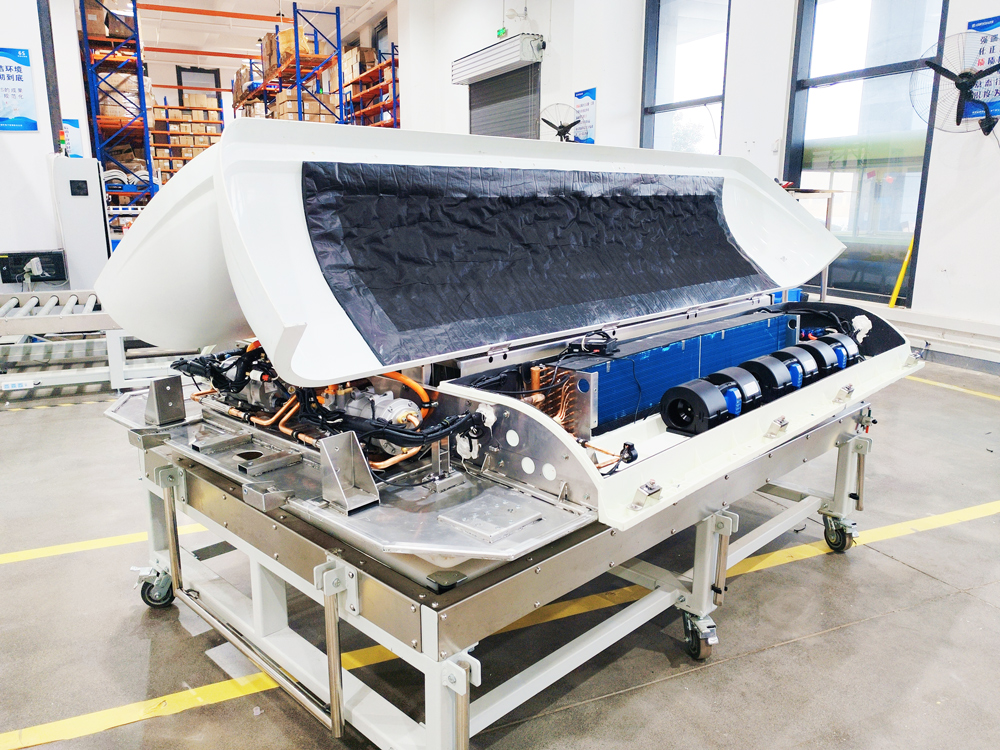
Uneven cooling is the "silent killer" of battery packs. As a NEWBASE technical expert, I explain how our integrated thermal management system ensures a temperature variance of within ±2°C, extending battery lifecycle by up to 3 years.
Batteries are More Than Expensive—They are Fragile
For electric bus operators, the battery pack is the single most valuable asset in the vehicle (often accounting for 30%–40% of the total vehicle cost). But as an engineer who has spent years studying thermal logic, I must tell you: batteries are incredibly delicate.
If you cannot ensure that the thousands of cells within a battery pack operate at the same temperature, the lifespan of the entire pack will be dictated by the hottest (or coldest) individual cell. Today, I’ll dive into how the NEWBASE Integrated System pursues extreme "Thermal Uniformity" to protect your capital investment.
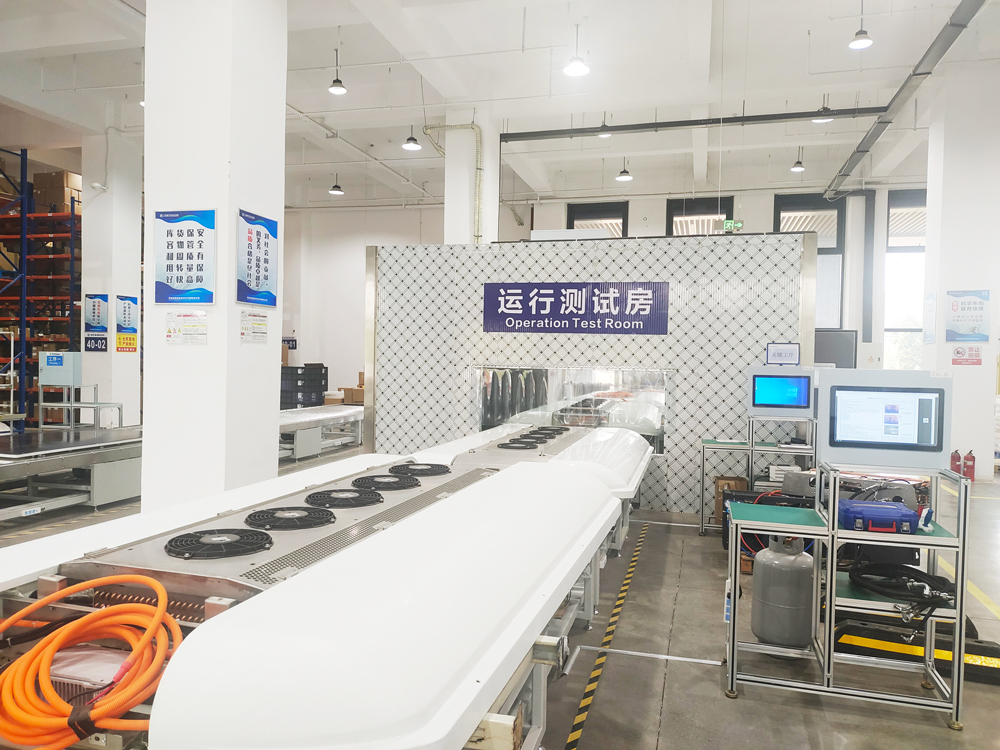
1. Why "Thermal Gradients" are the Silent Killer of Batteries
In a BTMS for Electric Bus (Battery Thermal Management System), our biggest fear isn't just high temperature—it’s the "temperature delta" (the difference between the hottest and coldest points).
If the front of your battery pack is at 25°C while the rear is at 35°C, you face three major risks:
Uneven Aging: Cells in the high-temperature zone will degrade much faster than those in the cooler zone.
Internal Resistance Imbalance: Temperature variance leads to different resistance levels across cells. This causes uneven current distribution during discharge, leading to localized hotspots.
The "Barrel Effect": The capacity of the entire battery pack is limited by the cell that degrades the fastest, forcing you to replace an expensive pack years earlier than planned.
2. How NEWBASE Achieves Precision Control Within ±2°C
To handle the heavy-duty cycles of commercial electric vehicles, our Battery cooling for electric heavy-duty vehicles employs a triple-layer protection strategy:
A. Flow Balancing Logic
Through Multi-channel Electronic Expansion Valves (EEVs), the system dynamically regulates the flow of refrigerant/coolant to the battery cooling plates. We use advanced thermal simulations to ensure that as the cooling medium flows through each module, the heat extraction remains perfectly consistent.
B. Intelligent Load Prediction
Using our Smart PID Control Algorithm, the system doesn't just wait for the battery to get hot. It predicts heat spikes based on the vehicle’s climbing, acceleration, or rapid charging status. This "proactive" management prevents the large temperature swings that stress battery chemistry.
C. High-Density Sensing Matrix
We integrate multiple P+T (Pressure + Temperature) Sensors throughout the system. The system samples data multiple times per second, allowing the "brain" to catch and correct even the smallest thermal deviations.
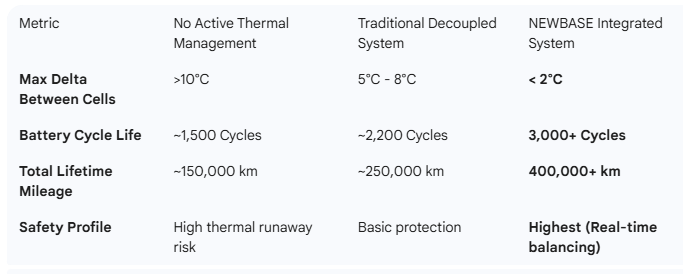
3. Data in Action: The Impact of Thermal Management on Battery Life
4. Safety: The Bottom Line That Matters Most
In extreme conditions—such as sustained high-speed driving or high-rate fast charging—the heat generated by batteries is immense.
The NEWBASE Integrated HVAC & Battery Thermal Management System has one core advantage: it can "borrow" cooling capacity from the cabin AC circuit at any time. If sensors detect an abnormal temperature spike in the battery, the system automatically enters "Emergency Cooling Mode," prioritizing all refrigerant flow to the battery to prevent Thermal Runaway.
Conclusion: Making Your Assets Age Gracefully
In long-term zero-emission transit operations, saving money is the same as making money. A superior BTMS is not an expense; it is a value creator. By keeping battery temperature variance within a microscopic range, NEWBASE helps your fleet run further, longer, and safer.
Want to see how your specific battery pack can achieve better heat dissipation?
Our technical team can provide thermal balance simulation advice based on your battery pack parameters (liquid-cooled or direct-cooled).